Natural History Habitats Habitats - Moorland
Habitats - Moorland
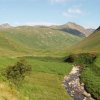
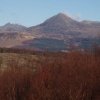
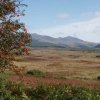
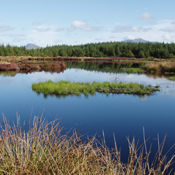 A very large proportion of Arran is made up of open moorland which ranges in altitude from about 450m to close to sea level.
Characteristics
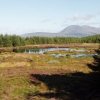
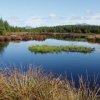
A very large proportion of Arran is made up of open moorland which ranges in altitude from about 450m to close to sea level. Arran’s moors are characterised by a blanket layer of peat scattered with a patchwork of wet pools and lochains. In many places there is thick heather cover, although large areas are also dominated by tussocky Molinia grass and dense stands of bracken. Other common plants of the moors include moisture tolerant species such as sphagnum moss, cotton grass, bog asphodel, soft rush and bog myrtle as well as carnivorous sundews and butterworts. Scrubby trees include rowan, downy birch and eared willow. Trees are often restricted to steep sided river banks where there is less grazing pressure from sheep and deer.
Where
Moorland is found all over the Isle of Arran, with the main areas being in the centre of the south, and around the fringes of the northern hills. Much of it is fairly inaccessible to the hill walker, as the terrain is difficult and there are few paths, but a drive over the Ross Rd will take you across the top of the southern moors, and a walk to Machrie Stone circles is a gentle stroll through one of the richest areas of moorland close to sea level.
Species Highlights
Ground nesting birds such as red grouse, curlew, skylark and meadow pipit are common on the moors of Arran. It is also a great place to see many species of birds of prey, including buzzard, kestrel, hen harrier and short eared owl. Mammals include the field vole, whose tunnels and runs can be seen in the long grass, and red deer, which are particularly abundant in the north of the island. The moors are a great place to find insects, and as well as the famous Arran midge, you may spot the ginger and brown furry caterpillars of the northern eggar moth- the moth itself flies in June-August.
When Highlights
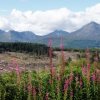
The moors come to life in early spring as the breeding season gets underway. Look out for skydancing hen harriers in April and territorial meadow pipits throughout the summer. August is the month that the most abundant species of heather, Calluna vulgaris, or Ling, comes in to full bloom, carpeting the hillsides in purple and pink. The colours in Autumn are also spectacular, and during October the annual red deer rut takes place and the moors come alive with the bellowing and roaring of stags.