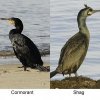
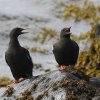
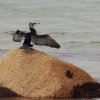
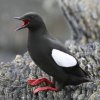
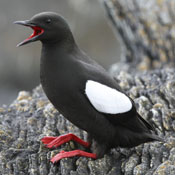
These enigmatic little seabirds have become more common over the last few years. They are predominantly black but have very distinctive white patches on their wings. The gape of their beaks reveals a bright red mouth and when they are out of the water their legs can be seen to be the same striking red.
Where: regularly seen in the sea round pier in Brodick. Larger numbers in the north and west particularly between Catacol and Lochranza but are present in most coastal locations.
When: they are present all year but in the winter spend most of their time far offshore and moult into greyer plumage, but still with the white wing patches. Return closer to shore in March for the breeding season.
Red-breasted Merganser
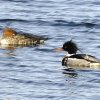
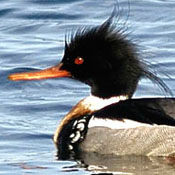
The population of red-breasted mergansers round Arran is significant enough to make it of national importance in Britain. The drakes have dark green heads, chestnut breasts, a white neckband and grey backs and flanks; the females have chestnut coloured heads and necks with duller grey bodies. Both the drakes and the ducks have thin crests and hooked reddish beaks which have serrated edges to help them catch and hold the small fish which they feed on. They can be seen in ones or twos, but sometimes congregate in groups of well over 100. On occasion they can be seen darting along the waters surface at great speed being almost obscured from view by the spray they create.
Where: all round the coast. Larger groups can usually be seen on the West coast from Machrie north
When: all year, larger groups are usually seen in June and July.
Eider
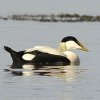
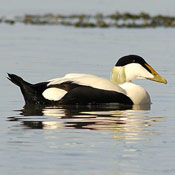
Eiders are the commonest duck round Arran. The drakes are very conspicuous with black and white plumage whilst the females are brown. The drakes can be very vocal as the breeding season approaches making a very distinctive “ah-hoo” call. Once the ducklings have hatched it is common for the broods form into a large crèche looked after by several females.
Where: they can be seen close to shore round most of the island, sometimes in quite large groups.
When: Most of the year, except late August and early September.
Gannet
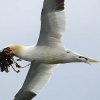
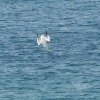
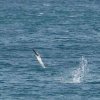
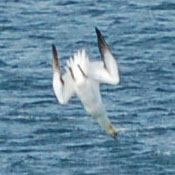
These large seabirds are mostly white with black wingtips and pale yellow heads making them very distinctive as they glide effortlessly above the sea. They have a wingspan of 1.6-1.8 metres and large powerful looking grey beaks and hunt by scanning the sea, sometimes from a height of up to 50 metres, for fish. Once they have located a fish the gannets dive headlong into the sea reaching speeds of up to 60 mph (100kph) as they enter the water- making gannets a marvel of the natural world.
Where: Gannets can be seen all round Arran, but they don’t nest here. Over 35,000 nest on Ailsa Craig, the island 20km south of Arran. At times large groups can be seen in a feeding frenzy when a large shoal of fish is discovered.
When: They return to the Clyde in late January with numbers gradually increasing. By April they become a more common sight until the autumn when they head for warmer climes with most being away by October.








 These enigmatic little seabirds have become more common over the last few years. They are predominantly black but have very distinctive white patches on their wings. The gape of their beaks reveals a bright red mouth and when they are out of the water their legs can be seen to be the same striking red.
 The population of red-breasted mergansers round Arran is significant enough to make it of national importance in Britain. The drakes have dark green heads, chestnut breasts, a white neckband and grey backs and flanks; the females have chestnut coloured heads and necks with duller grey bodies. Both the drakes and the ducks have thin crests and hooked reddish beaks which have serrated edges to help them catch and hold the small fish which they feed on. They can be seen in ones or twos, but sometimes congregate in groups of well over 100. On occasion they can be seen darting along the waters surface at great speed being almost obscured from view by the spray they create.
 Eiders are the commonest duck round Arran. The drakes are very conspicuous with black and white plumage whilst the females are brown. The drakes can be very vocal as the breeding season approaches making a very distinctive “ah-hoo” call. Once the ducklings have hatched it is common for the broods form into a large crèche looked after by several females.
 These large seabirds are mostly white with black wingtips and pale yellow heads making them very distinctive as they glide effortlessly above the sea. They have a wingspan of 1.6-1.8 metres and large powerful looking grey beaks and hunt by scanning the sea, sometimes from a height of up to 50 metres, for fish. Once they have located a fish the gannets dive headlong into the sea reaching speeds of up to 60 mph (100kph) as they enter the water- making gannets a marvel of the natural world.